« Closed for Christmas: The Ghost of Christmas Past | Main | Closed for Christmas 2: The Megachurch Response »
December 13, 2005
Beyond Sermons and Songs: Why Experiential Worship Isn't Enough
Churches pour enormous resources into creating meaningful worship experiences. But what if those experiences don't carry the meaning we intend? Pastor and theologian David Fitch believes a worship experience by itself is not enough in our postmodern culture. Instead he calls us to think beyond sermons and music to create a new framework for understanding worship that may not be new at all.
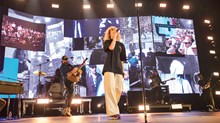
At our theology pub last month we sat around and conversed on the issue of worship. I put forward the typology of "lecture hall" versus "rock concert" as the primary modes of worship for evangelicals, and I suggested that both were inadequate for forming truthful minds and faithful experience in Christians.
The people at our pub ranged in age from 16 to early 50's. Most seemed to agree that a worship service geared entirely towards a 55 minute sermon seeking to dispense information to Cartesian minds is inadequate for spiritual formative. Less obvious and hotly debated was rock concert-style worship's ability to form us into Christlikeness.
I continue to assert that a sufficient theology of worship must come to grips with the epistemological shifts of the last century whereby we can no longer be naive that a "religious experience," like the one sought in a rock concert worship service, provides immediate access to God. Experience is something learned and trained into. An experience is produced through interpretive frameworks, particularly language. As Lindbeck would say, "there is no uninterpreted experience." This is one reason the evangelical church must move beyond the "rock concert pep rally" if we wish to recover a worship that shapes truthful minds and faithful experience. Rock concert worship produces an experience, but then fails to give people a framework to interpret it.
Carl Raschke's The Next Reformation: Why Evangelicals Must Embrace PostModernity (Baker, 2004) argues that charismatic worship is the best way forward. I am certainly grateful to Prof. Raschke for his analysis and am in agreement with him on many points. Still, I am puzzled by Raschke's proposal that evangelicalism embrace charismatic worship experience as an engagement with postmodernity. He states:
Charismatic Christianity is emblematic of the new postmodern evangelicalism. It is multicultural, global in scope, and interracial. It is post denominational, not simply non denominational. It is post propositional and post theological. For the most part it is more biblically oriented than many of today's so-called Bible churches. The dance with the Lord is the dance of the believer in the full presence of, and in full relationship with the Lord of heaven and earth, who is the Lord of the dance. Dancing, like genuine faith, is an intimate experience.
I think I get what he finds attractive about charismatic churches from this quote. I find all of this attractive as well, including the multicultural-interracial-global nature of charismatic churches and the authentic self expression that is found in their worship. But if the theologians are right and there is no "uninterpreted experience" than even the Charismatic worship experience alone cannot be the answer.
However, this does not require us to forgo charismatic experience, or any authentic experience of God's presence in mystery and transcendence. Rather, we must go to the deep, rich, and historic liturgies of our history in Christ that help people properly interpret the worship experience. Instead of seeking a spontaneous experience without a framework to understand it, let us return to the mystery centered around His Table, let us return to symbol, poetic prayer, liturgical participation, creedal affirmation, historic confessions, great responses in music and song all born within an arena of worship that is made accessible and beautiful by the liturgists, artists, and curators of our churches.
This then is where experience is shaped and formed out of our relationship to God. This does not mean a return to dry, dead, rote liturgy. Rather let's make liturgy alive and accessible just as several of our emergent church brothers/sisters are attempting to do. As the emergent church seeks to take evangelicalism (and others) past modernity, we will only find authentic charismatic experience in these postmodern times through the passageway of renewed liturgical practices that provide both an experience and a framework to interpret it. I think the AMIA churches (Anglican Mission in America) are evangelical churches in our midst that are showing us the way in this regard. And I think there are several other emergent churches doing the same.
David Fitch is pastor of Life on the Vine Christian Community in Long Grove, Illinois, a professor of ministry, theology, and ethics at Northern Seminary, and author of The Great Giveaway: Reclaiming the Mission of the Church from Big Business, Parachurch Organizations, Psychotherapy, Consumer Capitalism, and Other Modern Maladies (Baker 2005).
Comments
Let us return to the line by line study of the Word of God. Then judge our experiences against that.
Posted By: RDM | December 13, 2005 9:58 AM
Sometimes it seems no matter what we do, someone is telling us we aren't doing worship right.
Posted By: dabeirne | December 13, 2005 10:26 AM
It seems to me the key is that worship is about God, and not ourselves. And the concept of worship is far broader than "line by line Bible study" or singing specific styles of music, or Sunday morning meetings, or any of that.
Worship is what we do with our life.
And if we individually, on a daily basis, present our lives to God as a sweet sacrifice, then when we come together to jointly worship him, the details will not matter. True worship is to declare with our lives the worthiness of GOd.
Posted By: Larry Baden | December 13, 2005 1:31 PM
Worship consumes the lion's sahre of the resources of a church. But it is not the center piece of faith development. However worship is conducted, experientially, liturgically, casually, it still occupies a single period of time in the week. Worship may color how we approach community in small groups or our personal devotional time, but it is not what makes our journey of faith sustainable. We can all make cogent arguments on why our perferred approach to worship is the right one, but it is still a small fraction of our week. Maybe if we shared and shaped each others worship life rather than critiquing them we would find greater satisfaction. Maybe just little more grace wouldn't hurt either.
Posted By: Kent | December 13, 2005 2:28 PM
The conclusion is illogical. The premises presented do not support the conclusion. It simply does not follow that since we need a “framework” for worship for understanding – we then need liturgy. Can you smell the agenda? Have you noticed that no one ever ask questions unless he or she has prepared answers? If it is framework (whatever that is supposed to mean) that we need (big if), then why cannot it be added to ANY style of worship?
I would like to point out to David Fitch the emphasis in the push for Charismatic-style worship is the need for the Holy Spirit. Ask this question and seek an answer, don’t come with a prepackaged, demand for your answer: What is the role of the Holy Spirit in worship?
Ask your church. Ask God. Remember the promise from Matthew 7.7 “Keep on asking, and you will be given what you ask for. Keep on looking, and you will find.”
Posted By: david | December 13, 2005 3:53 PM
David Fitch raises some good questions.
I have one more.
Why do we insist on thinking of worship as a Church activity?
Like Larry Baden said, my entire life should be filled with worship. This doesn't mean that I hum Christian songs while I work or try to sell cheap Jesus to my neighbors. It means I recognize God's glory in every part of my life.
Last night the Worship Minister at my church cut choir practice short so we could have a Christmas party. The prayer before the meal was interesting. We thanked God for letting us worship him in song. And then thanked him for giving us the opportunity to worship him by having a Christmas party.
Every good thing comes from the Father. We worship him by finding contentment in the good things he has given us.
Posted By: Mark | December 13, 2005 5:03 PM
If the motive is to glorify God and the result is that hearts are turned to Him, then it is worship--bound only by reasonable moral standards. Scripture is the framework; we add the rest.
Posted By: Brent | December 13, 2005 9:00 PM
I see the church defining worship as: music. Our worship pastors are musicians, we get together for worship and we sing. What the musicians don't seem to realize is that for some all they are doing is producing noise, that is not at all conducive to worship. Worship is using the gifts that the Holy Spirit has given us for the glory of God and His kingdom. For some that is conveying the gospel message after building relationship with kids at a sports camp. Or conducting a Bible study at the local pub where people come to know Him. Worship is how we sacrifice ourselves to Him and come to know our Saviour more intimately. Music is only one of many ways for this to happen, but for some of us music is the least favourable way to worship.
Please stop defining worship as music.
Posted By: Brian | December 14, 2005 9:59 AM
What is described as liturgy above is far too narrow. Remember, churches in the past were married to the states or nations they were in. There is a lot of cultural baggage, in other words. Singing rock and roll and preaching expository style messages are as much liturgy (worship) as candles and chants. There is beauty in both, perhaps, but really there is freedom. As long as the liturgy focuses on Christ as the center, then we should not fear it. Indigenous worship is more important than what the western church did 300-400 years ago.
Don't get me wrong. Music can be bad if it is self-focused, and preaching can be bad if it is psychology. That is where the "framework" issues come into play. It is content that is biblical, not forms that are culturally temporal that provide framework.
Posted By: Rich Kirkpatrick | December 14, 2005 10:42 AM
Thank you for this. As an evangelical in his early twenties who constantly grapples with the marketing and feel-good focus of popular evangelicalism, I find myself (as well as many of my closest friends) increasingly drawn to liturgical styles. I don't know what is so frightening about daring to acknowledge and appreciate a form that allows us to glorify God without watered down theology or intellectually-stilting church services. It seem that if popular evangelicalism continues to disregard its own historical forebearers, it does itself a great disservice.
Posted By: Ryan | December 14, 2005 12:29 PM
A small group I was in recently had a nice long conversation about the nature of worship and the purposes of our "worship service" at church. It was interesting to see that we typically associate the term worship with singing songs at church, but delving deeper into the idea it becomes clear that a corporate gathering where we sing is really the smallest part of worship.
Our church is strange mix that incorporates liturgy with some regularity and really enjoys it, but liturgy or charismatic worship are not the answers. We need to rethink what we call church and realize that the structures we create can be empty and distracting whether they incorporate liturgy or not. Church is about being the body of Christ. Deliberately gathering to sing songs and receive instruction is only one small obligation that we have as members of that body, yet it is typically the only one to receive significant attention. Jesus didn't pray that we would worship effectively together, he prayed that we would share a relationship like the one he had with the Father, so the world would believe it was loved by God and that Jesus was really sent by the Father.
Posted By: Scott Ramsey | December 14, 2005 2:04 PM
Knee jerk reactions and condescending exercises in linguistic violence notwithstanding, I think it is unfair to accuse Dave Fitch of having an "agenda" here, as if he were engaged in something sneaky and dishonest. And why is it considered a "prepackaged" answer if a person has through many years of thought, prayer, study, and experience come to believe certain ways of doing things are better than others? I get really frustrated with people who think that openess to the Holy Spirit is not compatible with having a definite view of things.
Nor is there any necessary contradiction between being open to the role of the Holy Spirit in worship and having a definite liturgical structure. People often think they're free of liturgy because they don't attend a litugically formal church, but I think this is false and dangerous. We always have some kind of a liturgy, in the sense that our service is always ordered in some way towards some particular end. That being the case, the question is not whether or not to be liturgical, the question is whether we have a liturgy that is shaping us more into the character of Christ or is shaping us in other directions (and it is shaping us, whether we like it or not).
My own thought is that while more formal liturgies do face the danger of becoming dead, rote repetition, that they at least tend to have the strong theological/truth content present in them that can allow us to transcend our own small world of experience if we will submit ourselves and thoughtfully enter into them. More informal liturgies, which lack strong content and are often nonexplicit, face a greater risk of simply reinforcing, or at least not challenging, the already ingrained thought and behavior patterns of their participants.
Saying that worship is life activity and not a church activity is all well and good, but I think the point is that we are all part of the church, and the time we spend together as a body of Christ in corporate worship shapes us in particular ways which have a definite affect on the way we live. If we are not being shaped into the character of Christ through our corporate Christian life, then saying that worship is a life activity doesn't get us very far.
Posted By: Gordon Hackman | December 14, 2005 8:25 PM
Scott, I definitely agree that we need to rethink the church so we can be the body of Christ in the world. And I agree with all that has been said relating to Romans 12:1-2.
But it has always been a part of the church to gather together and celebrate on the Lord's Day corporately. And their is something very significant about the public, communal worship of God that should be taken lightly. I think it is so easy to say things like "we should all worship all week long," and "Sunday worship is not really that important" when really it is important. To disregard corporate worship is to forget all of church history and to disagree with most of the global church.
And I don't think David is making any hard argument for a particular liturgy, just pointing out that a "line by line" preaching of Scripture or a looking for the Holy Spirit might not be enough. I have been a part of churches like this and they can still tend toward legalism, narcissism, and inauthenticity. It doesn't seem that David is against preaching the Word, only against reducing the powerful Word to mere 'information' (which frankly I've heard plenty of with little really sanctification happening). And he not against the Spirit, but realized that our entire culture is about having experiences, so we need discernment about which spirit we are following, the Holy Spirit or the spirit of the air and age.
Why is everyone so afraid of liturgy (except for Ryan)? As a younger evangelical and as a worship pastor, I love liturgy. and while not a member at a liturgical church, we do many things which are bear great fruit.
Posted By: Geoff Holsclaw | December 14, 2005 8:32 PM
I see no fear in liturgical worship by people in this post. What is wrong with "both and" in this case? Culture to culture we respond to things differently and so we do as one person to another person. We should not judge some form of worship expression because we prefer something else. Biblically, there is a lot of freedom. Culturally, there is a lot of diversity.
One point that should be made is that our worship this side of heaven really will not be more than a glimpes of heavenly worship. Our dissatisfaction at times is a clue that there is always more with God and eternity.

Posted By: Rich Kirkpatrick | December 14, 2005 11:16 PM
We are all the church. The small congregations that gather to worship God should reflect the "culture" of their particular congregations. We gather to expres our collective praise of Jesus Christ, God's Son; the faithfulness of God Almight to reign and love us; and, bring offerings of ourselves and our material blessings to be used in God's work. Worship does not include bake sales, music focused away from our worship of God, and preaching that deviates from the written Word of God. What a congregation looks like from one geographic location to another and how a congregation expresses its profound worship of God should vary from neighborhood culture to neighborhood culture. The amazing thing about "right worship" is that it prepares us to live in the world as if the Holy Spirit has tweaked our lives to love others with mercy, seek justice and walk humbly with God.
Posted By: elliott | December 15, 2005 9:28 AM
I remember back when I had my first position as a worship leader. All the debates on this blog were just as prevalent then--22 years ago. I lived through 4 church splits, mostly over differences in how people thought worship should be. It was embarassing. God wasn't in any of it. But, I struggled for answers as much or more than anyone because having the "right" worship service was my responsibility.
One day I was was lamenting to my dad about my dilemma. He's a quiet man. Quiet about his religion too. Never quite holy enough for me back then; struggled with cigarette addiction, occasionally let a cuss word roll from his tongue, and, while I never saw him drunk, he enjoyed a cold beer at the end of a hot summer's day. He was a jack-of-all-trades and master of most of them. There wasn't much he couldn't do and do well.
But, as many from his generation, he was quiet about his faith.
When I got off my tirade over the problems we were having at church agreeing over how to worship, he came out from under the hood of his neighbor's car that he had been repairing for him, lit up a cigarette, inhaled, exhaled, and then began, "Son, if someone gave his life for you, shouldn't it be said of you that you worship the ground He stood on, and wouldn't you be compelled to help him out in any way you could?" I acknowledged affirmatively. "Well," he continued, "The Bible I read tells me that Jesus said, "Whatever you do for the least of these, my bretheran, you have done unto me. So, I'm working on Robert's car right now because, Robert is, in essence, Jesus. You see Robert doesn't have much money and he doesn't know how to fix his own car. And it's not like there aren't some things I want to do for myself, but there ain't a one of them more satisfying to me than makin' life a little easier for old Robert, cuz, he's Jesus. And when I put in that wheelchair ramp for Mrs. Juray when she got home from the hospital, I was much obliged cuz I really knew it was Jesus whom I was building the ramp for. And when your mom would invite all the bums in for dinner or to our picnics when you were little, those bums were Jesus." I was beginning to vaguely see his point. He took another drag off of his cigarette, "Son, Jesus is everywhere you look, and it seems like the church just passes him by. But,whenever I do something for my fellowman in their time of need, I'm worshiping the One who died for me, and I am returning my gratitude for what He did. That is true worship the way I see see it, son. And the way I see it, until church people "get it" and until I see them bein' Jesus rather than robbin' from him to build a bigger, more comfortable place to park their butts on Sunday morning, they are destined to continue arguin' yet never learnin' what it it means to worship the Son of God."
That was perhaps the most profound and convicting sermon I've ever heard. And that was the last time I ever judged my dad regarding his spirituality. Like everything else he did, he understood the heart of worship better than most of us ever will.
It has forever changed the way I view worship. As I see it, if a church isn't coming together on Sunday morning praising God for all that happened during the week as they were the hands and feet of Jesus to their community, the preaching and singing rings hollow no matter how good it is. But, when God's people are witnessing his love and compassion to those in need, what happens at the worship service is Spirit-filled beyond description no matter how loose-ended and out of key it is. And when that kind of joy floods a worship service we get to experience first-hand what it looks like when Jesus dances!
Posted By: John | December 15, 2005 3:05 PM
John, this is a good word, but I think the point Dave is trying to make is that how we organize and conduct our corporate worship can affect the kind of people we become and therefore, affect how we love and serve our neighbors during the week. Corporate worship is one of the places where we come to be shaped as a community into the character of Christ. Certain ways of doing church may have more of a tendency to reinforce our individualistic self-centerness, while certain other ways may have a greater possibility of taking us out of ourselves and our small world of personal experience. This will help to shape us into the kind of people who are capable of loving our neighbors. The dynamic runs both ways. Our life and conduct as a body of Christ, and our daily lives as individual Christians should continually be positively affecting each other.
Posted By: Gordon Hackman | December 15, 2005 5:02 PM
Gordon, I couldn't agree more. The reciprocity of day-to-day worship and corporate worship is certainly essential. The problem is in effectively communicating the need for the body to allow their daily lives to interact with the weekly service.
It is quite tempting to lean toward making it all a big show and reduce its real usefullness for us the rest of the week.
The bigger the church, the more prone it is to trying to "do it all" and leave nothing really vital for challenging the individual members to "be Jesus" in the rest of their lives apart from church.
Obviously some get it and some never will. But, I have found that the more we allow the excitement of people's lives during the week to be shared as an integral part of the worship service, the more people begin to see their own worth as true believers when they walk out the doors.
If worship doesn't spawn and encourage us to become the hands and feet of Jesus outside of church and then validate our victories when we join together, it fails to accomplish the essence of its true purpose.
The story about my dad is case in point. Back then, it was so easy for me to judge his reluctance to involve himself in corporate worship as being unspiritual when in reality, his spirituality not only outshined my own, but it exposed my hypocrisy. The rest of the story is that his own testimony suddenly became an asset to the rest of us at church and was the beginning of setting a whole new precedent for us in terms of our outreach to the community. And of course, Dad began to see that our church was becoming worthwhile of his attendence and he became involved with us regularly.
I just discovered this blog site and there is some great thought provoking discourse here. Glad I stumbled into it. :)
Posted By: John | December 16, 2005 4:12 AM
Pharisees and Scribes take heed, legalism will get you nowhere. The church is the bride of Christ but that doesn't mean that the wedding ceremony has to look the same to everyone. If God calls you to a certain place to worship, you would be wise to be thankful that God called you at all, and you should worship Him no matter what form of corporate and individual worship style that might be. When you put I or we at the forefront of your point of view, you put yourself ahead of God and that is a bad thing.
Posted By: David | December 16, 2005 8:13 AM
It seems to me that some of this debate is fairly clearly settled if we take a different view on worship altogether. Rather than seeing it as being about God and not about us, I think we should look at it as very much so about us. I think that we go to church for 1 primary and 1 secondary reason. The primary is to hear the word of God, which brings forgiveness of sins, read and preached. The secondary is to give thanks to God for that Word and for His Son, who died on the cross to win for us that forgiveness. That said, I believe that the center of my spiritual life is very much so that hour or 1:15 on Sunday morning. As the week and the world drag me down, Sunday Church stands there as a certainty, to bring me back up.
My church is very liturgical, but I appreciate it, because I know that largely on that basis, the certainty stands.
Posted By: Jacob | December 16, 2005 10:59 AM
When we say that worship “means I recognize God's glory in every part of my life", what we are really saying is that we should try to force ourselves to be in some vaguely devotional mood all the time, and this just isn’t possible. Like it or not, our mood is affected by what we do and what we experience. This is the whole reason for setting aside a special period for worship, whether it be daily or weekly. It’s like making a date with my wife. Sure I try to keep my emotions toward her positive all the time, but setting aside special time specifically for interaction with her, in a special setting (restaurant, park, etc), strengthens our relationship and underscores its value. So just saying that we walk around thinking God is great all the time is not as good as doing that PLUS going to church.
Posted By: John | December 17, 2005 12:20 PM
"That is true worship the way I see see it, son. And the way I see it, until church people "get it" and until I see them bein' Jesus rather than robbin' from him to build a bigger, more comfortable place to park their butts on Sunday morning, they are destined to continue arguin' yet never learnin' what it it means to worship the Son of God."
The story was fine until that point. With those words, this man became the Pharisee in Luke 18:11. It's one thing to live your life in a charitable way to others. But divorcing yourself from the Church because you see yourself as doing it right while they are doing it wrong is simply a self centered rationalization. Even sacrificial charity is just a good work. Attitude is everything. We should love unconditionally even those we see as "doing it wrong".
Posted By: RDM | December 18, 2005 6:54 PM
To quote Fitch, "...let us return to the mystery centered around His Table, let us return to symbol, poetic prayer, liturgical participation, creedal affirmation, historic confessions, great responses in music and song all born within an arena of worship that is made accessible and beautiful by the liturgists, artists, and curators of our churches."
I humbly submit that this is a sure fire way of moving into the same spiritual darkness that encompasses Europe because they abandoned Evangelicalism to "return" to the model proposed here by Fitch.
Posted By: Blind Beggar | December 19, 2005 8:38 PM
It is amazing to ponder what all this discusion looks like from heaven. A creative God watching his linear offsping trying to reform a box.
We have a culture that embraces 2 hour programs every where except the church. Can you imagine if all movies, theater productions, sports events had to conclude in an hour. Maybe if we presented more creativity, varied the menu, and left folks wanting more we would see this debate from another angle.
Here is to a new year full of fifty minute sermons, charismatic, and emerging worship, sprinkeld with insightful liturgical moments that awaken our spirtitual insticnts to the prescnce of an interactive God.
Here is to houses of worship that are pursuing new places while broadening the menu rather then reheating leftovers.
Here's to Christmas services that celebrate his Birthday as if he was the guest of honor.
Merry Mass of Christ.
Posted By: Robert Reasner | December 20, 2005 1:50 PM
It seems like many in the blogs and in the article are quoting from a lot of sources other than scripture.
It's funny how we debate in the church about what worship is or isn't but none can truly judge the heart of a man and say they aren't really sincere or because they have guitars and lights or an organ and candles they have veered from the "truth".
Jesus said, "I am the truth..." If we are focused on Christ and glorifying Him then we are in worship.
None of these debates profit us because the unsaved and the unchurched don't care about this...they need to see Godly love and an environment where people aren't fighting each other over preferences in music. This article is so heady that we miss the simplicity of our true calling as the church.
It's not about Charismatic churches and experiential worship but if that's where your focus is then truly Satan has pulled you into jealousy over another's success and your focus can't be on Christ if you're spending all your time examining others and judging their worship.
Posted By: Ricky Hall | December 21, 2005 7:39 AM
To RDM, you missed the point. My dad never divorced himself from the church, but neither did he involve himself with all the arguments. He simply lived to serve others and quietly set a Christ-like example for all.
It wasn't until that point that I began to understand worship myself. His take on our worship struggles at church was voiced to no one but me. He never judged anyone and only then because I asked for his input. If anything, his entire witness was anything but pharisaical. But, up to that point, the rest of us were just that.
Posted By: John | December 22, 2005 5:52 PM
thanks..
Posted By: anlat.net | December 28, 2005 7:36 PM