Do our spiritual practices insulate us from the benefits of pain?
UrL Scaramanga
In a recent issue of New York magazine, Adam Sternbergh accuses, "You Walk Wrong." And I can't help but think that his insight into feet has spiritual application for Western Christians.
As the title suggests, Sternbergh claims that none of us walks correctly. But it's not our fault; it's shoes. "Shoes are bad," he claims. In fact, he cites researcher William Rossi as saying, "Natural gait is biomechanically impossible for any shoe-wearing person." After comparing the feet of 180 people from different cultures, along with a few feet from 2,000-year-old skeletons, researchers concluded that feet were healthier before shoes became fashionable (the skeleton feet were better off). And people who don't wear shoes - Zulus, in this case - have healthier feet than we Westerners. Athletes who wear cheaper, less padded, shoes have fewer injuries. Elderly people with back, knee, and hip problems report less pain when barefoot. This is, to oversimplify, because feet absorb shock better than shoes (because they flex) and because we walk lighter when barefoot (because we can feel the ground).


Growing up, I loved the feeling of shag carpet and cool mud between my toes and feeling the earth as God made it, with all its points and sharp edges. So I was particularly pleased at Sternbergh's conclusion: that our feet - and the rest of our ambulating parts by extension - are healthier when we avoid the temptation to wrap them in foam. Lacing up to avoid the momentary discomforts of walking unshod causes long-term problems, because although our feet adjust to walking without shoes, our joints never adjust to walking with them.
"To me, the church should not aim to be 'real' as an end. The church is there to proclaim truth. Trying to be hip and cool and real does a disservice to the church. We're not called to be successful. We're called to be obedient, even if they don't come.... If somebody doesn't find you objectionable, I wonder if you're preaching the full counsel of God."
-James Gilmoreis co-author of Authenticity: What Consumers Really Want (Harvard Business School Press, 2007). Taken from "Keeping It Real" in the Spring 2008 issue of Leadership journal. To see the quote IN context, you'll need to see the print version of Leadership. To subscribe, click on the cover of Leadership on this page.
Is there only one gospel? And what is the difference between the gospel message and the implications of that message? Can we preach one without the other?
The desire to reach out and a new focus on spiritual formation are changing the way we preach the gospel.
UrL Scaramanga
Our friends over at Preaching Today have launched a new series on preaching the gospel. They're asking, "Is our gospel too small, or is it too big?" and "What does it mean to preach the gospel in today's culture." They've begun with an interview with Leadership's own Skye Jethani. Below is an excerpt. You can read the entire interview here.
Preaching Today: A number of Christian authors, pastors, and theologians are raising critical questions about our understanding of the nature of the gospel. What do you think has stirred such passion?
Skye Jethani: A lot of passion has been fueled by the angst produced from conversations about how to reach younger, postmodern generations. Two schools of thought emerged from the beginning. One group opted for the conservative approach: we just need to be more relevant, repackaging the same gospel message in a manner or style that's going to be appealing to the next generation. Another group insisted the church needed to go deeper than repackaging the content. They felt we needed to rethink the content. A lot of today's conversations about the gospel were born out of the early tension between the two schools of thought.
A century and a half ago, Herman Melville (he wrote Moby Dick, but don't hold that against him) observed, "In certain moods, no man can weigh this world without throwing in something, somehow like Original Sin, to strike the uneven balance." It's remarkable to me that even today artists often come to the same conclusion: human experience doesn't quite make sense without some provision for inborn and radical evil. Even Hollywood has explored this theme in recent years. There Will Be Blood is a chilling story of humanity's incorrigible greed. Cormac McCarthy's novel (and the Cohen brothers' movie) No Country for Old Men deals directly with the concept of incarnate evil through Anton Chigurh, a villain who toys with human life mostly out of boredom. Apparently screenwriters are beginning to ask questions novelists have been asking for years.
G. K. Chesterton called sin "a fact as practical as potatoes" and original sin "the only part of Christian theology which can really be proved." Of course, not everyone takes it so seriously. Comedian Eddie Izzard calls it a "hellish idea. People have to go, ?Father, bless me for I?did an original sin. I poked a badger with a spoon.'" And there are those, too, like Oprah and Eckhart Tolle, who think too highly of human potential to entertain the idea of depravity.
"This divorce of APE (Apostle, Prophet, Evangelist) from ST (Shepherd, Teacher) has been disastrous for the local church and has damaged the cause of Christ and his mission. In my opinion, this contraction of fivefold to twofold ministry is one of the main factors in the decline of evangelical Christianity in the West. If we want a vibrant missional church, we simply have to have a missional leadership structure with all five functions engaged. It's that simple!"
-Alan Hirschis a leader of the Forge Mission Training Network in Australia, and author of The Forgotten Ways (Brazos, 2007). Taken from "Three Over-Looked Leadership Roles" in the Spring 2008 issue of Leadership journal. To see the quote IN context, you'll need to see the print version of Leadership. To subscribe, click on the cover of Leadership on this page.
Skye Jethani, David Swanson, & Matt Tebbe discuss the trend away from senior pastors.
UrL Scaramanga
The theme for current issue of Leadership is "Teams," and that is the subject of our first Out of Ur podcast. Teams have always been a critical part of ministry going back to the 12 unlikely men Jesus assembled and then sent out in pairs to reach the villages of Judea. But today teams are taking on new significance.
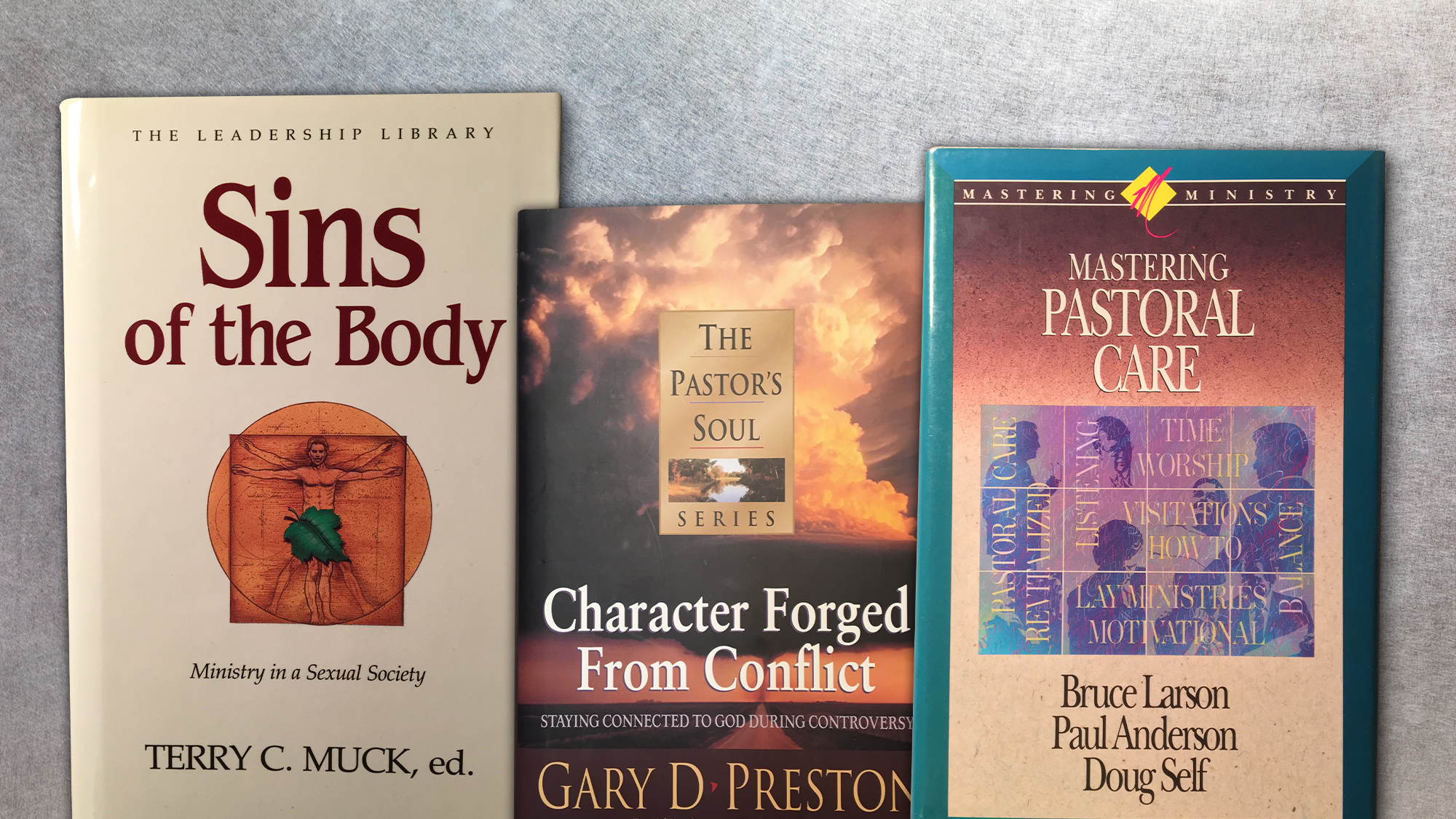
A guide for the next time you pick up a Christian leadership book.
UrL Scaramanga
Beware of any literature that starts with these words: "Jesus was the greatest leader of all time." The sentiment behind those words may be true, but the point they make is irrelevant. It doesn't matter if Jesus was the greatest leader of all time. Jesus is our leader (and, in a holy sense, we're stuck with him).
The issue at hand is far from nit-picky. Evangelicals have long been accused of domesticating Jesus - making him one of "us" (often white, middle-class, socially respectable, and politically conservative). The glut of Jesus-as-leader books runs a tremendous risk as it attempts to introduce Jesus into the economy that surrounds 21st century leadership.
Jesus the leader endangers our view of Jesus the savior. Frankly, Jesus the leader is less threatening. He's an organizational director that would fit in wearing business casual and sitting in a conference room. I believe wholeheartedly that Jesus wants to control how I behave, think, and lead in when I'm in the conference room, but I don't have much confidence in Jesus as the teacher of strategic leadership lessons.
Why young people are tired of personality-driven churches.
UrL Scaramanga
I haven't seen MTV in years, with no regrets, but I recall a show on the network that impacted me like a train wreck. It was awful, gruesome, and terrible - but I couldn't look away. "Celebrity Deathmatch" featured clay-animated celebrities in a wrestling ring where they pummeled, grinded, or dismembered each other into a bloody pulp of scarlet Play-Doh. It wasn't exactly wholesome family entertainment.
We can pick apart the moral depravity of the show (which is all too easy), or we can talk about why it was so popular with the young (which is probably related to its moral depravity). Let's simply draw this conclusion - the younger generation isn't enamored with celebrities. They aren't cultural gods to be worshiped and respected. They're more like rodeo clowns trying not to be impaled by the paparazzi beasts we unleash to devour them for our own entertainment.
The anti-celebrity sentiment of the younger generation, and the culture as a whole, may be taking root in the church as well. There are two seemingly opposite trends occurring among evangelicals that relate to this. One is the movement away from hierarchical leadership structures. The other is the movement toward hierarchical leadership structures. Let me explain.
A new manifesto says evangelicals have been co-opted by politics; will the next generation make the same mistake?
UrL Scaramanga
What is an "evangelical"? According to almost 80 prominent pastors, theologians, and activists, the word "evangelical" has become "a term that, in recent years, has often been used politically, culturally, socially - and even as a marketing demographic."
The group signed and released a 19 page "Evangelical Manifesto" last week in Washington D.C. The goal of the document is to "reclaim the definition of what it means to be an Evangelical." They believe that theological, rather than political, principles should define evangelicalism, and they offer a strong rebuke to those who would equate the word with either end of the political spectrum. When evangelicalism is politically defined, they say, it makes Christians "useful idiots" for politicians and parties.
The manifesto's signers are a diverse bunch including Timothy George, dean, Beeson Divinity School; Os Guinness; Richard Mouw, president, Fuller Theological Seminary; David Neff, editor in chief of Christianity Today; and Jim Wallis, founder of Sojourners magazine. Absent are some high profile Religious Right folks like James Dobson. Richard Land, president of the Southern Baptist Ethics & Religious Liberty Commission, has written about why he won't sign the manifesto even though he agrees with 90 percent of its content.
One commentator has noted that the manifesto represents a divide between the "old-style populist evangelicals" (think Religious Right, Moral Majority, pro-life, anti-gay marriage) and what he calls the increasing ranks of "cosmopolitan evangelicals" (think global awareness, social justice, poverty, AIDS). He says this bunch (shall we call them Cosmo-Christians?) are "the new public face of the evangelical movement."
Is there a significant difference between Jeremiah Wright's "God damn America," and the comment so oft-quoted in evangelical pulpits (attributed to a well known preacher who shall go unnamed): "If God does not judge America for its sins, He will have to apologize to Sodom and Gomorrah."
Don't quibble about word-choice; think substance. Is there a significant difference?
I figure Out of Ur is as good a place as any to answer MacDonald's question. Have at it.
Apparently Christians aren’t the only ones feeling the urge to emerge.
UrL Scaramanga
While following a relatively uninteresting trail of research recently (which I won't retrace here), I happened upon Synagogue 3000 (S3K). This consortium of rabbis and other Jewish leaders is committed to offering "challenging and promising alternatives to traditional synagogue structures." They call themselves "Jewish Emergents," and their understanding of their mission is, in some ways, very similar to that of the Christian Emergent movement.
They are concerned, for example, with communicating authentic faith in a postmodern idiom, which has compelled them to move worship beyond the synagogue. So, they are meeting in homes, bars, and coffee houses, among other places. They are resurrecting some ancient practices, such as worshiping in Hebrew, while ignoring others. And they are reconsidering the qualifications for participation and leadership.
There are also significant differences between Jewish Emergents and Christian Emergents, of course. Along with Synagogue 3000, Jewish Emergents seem more concerned with updating the style and format of Jewish observation and worship than with questioning or reformulating orthodox Jewish theology. Also, while the Jewish Emergents are eager to reconcile younger non-practicing Jews to the faith, they are not concerned with proselytizing.
"I think our generation is approaching ministry more as an art than a science. Since the Enlightenment, 'doing church' has been seen as a science, and it was seen as linear, organized, with clearcut leadership principles. Our generation doesn't see things that way anymore. We approach things more creatively, more organically."
-Dave Terpstrais teaching pastor of The Next Level Church in Denver. Taken from "Next & Level" in the Spring 2008 issue of Leadership journal. To see the quote IN context, you'll need to see the print version of Leadership. To subscribe, click on the cover of Leadership on this page.
Why the human race needs an administration of another kind.
UrL Scaramanga
Anybody but me notice that this is an election year? I have loved politics since I was a kid; one of my first and favorite books was a little Cold War classic called Being an American Can Be Fun.
But it's an odd thing. The church - where we're supposed to be fearless; where we're supposed to challenge people on sin, and be prophetic, and face martyrdom - the church is also the place where we're told, "Don't talk about politics!" Or at least we're told that in the kind of churches where I grew up. Other traditions are different. In the African-American church, for instance, for decades church was the one place where politics could be safely talked about; leaving a legacy that is reverberating pretty loudly this year.
Here's the problem: politics is an important sphere of human activity, and as such God is keenly interested in it. It was the Dutch theologian and politician (why don't we have more of those?) Abraham Kuyper who famously said, "There is not one inch of creation about which Jesus Christ does not say: ?This is mine!'"
However, as soon as human beings (including church leaders) start assuming they are in a position to pronounce God's political leanings, things get a little dicey.
How should the church respond to Grand Theft Auto IV?
UrL Scaramanga
I have a confession to make: I'm a thief and a murderer. I haven't actually killed a living, breathing human being (I have stolen a thing or two, though; mostly pens and pencils). But one summer in college, a roommate and I played Grand Theft Auto: Vice City until we'd both done pretty much every awful thing there is in the world to do, including killing and stealing.
And it was great fun.
The newest installment of the Grand Theft Auto series is anticipated to be dang near the most lucrative media release ever. Take-Two Interactive Software, the company that owns GTA creator Rockstar Games, expects to sell 9 million copies of the game by the end of their fiscal year in October. They expect sales to gross $400 million in its first week; that's a measly $1 million less than the top grossing movie of all time, Pirates of the Caribbean: At World's End, made in its first week.
Together the series of three games has sold around 70 million copies so far, which puts it in competition with (and actually slightly ahead of) Dan Brown's The Da Vinci Code (Doubleday, 2003). It will also be in league with Harry Potter and the Deathly Hallows, the last of Rowling's Harry Potter books, which sold 12 million copies in its first run in the U. S. Think of that: if the game's popularity is comparable to that of Harry Potter and The Da Vinci Code, there's no doubt that people in your church will soon be stealing cars and chasing women. Virtually, of course.
Now that the Da Vinci Code and Harry Potter comparisons have been made, that makes me wonder, What is the church to do with Grand Theft Auto IV?